
Need It Gone Fast? What to Send Before Booking a Cleanout
Need It Gone Fast? Send These Details First
When a property needs to be cleared quickly, the cleanout itself is only part of the job. The fastest way to get the process moving is to provide clear information from the start. A few good photos, the exact location, and the real deadline can help a cleanout company understand the scope before work begins.
That matters for commercial properties, tenant move-outs, office turnovers, storage areas, garages, and full homes. Missing details can create delays, access problems, or confusion about what should be removed. Clear details make it easier to build an organized plan and move the property toward its next use.

Start With Wide Photos
Photos are one of the simplest ways to explain a cleanout. However, close-up pictures of individual items do not always show the full amount of work involved.
Take wide photos from the doorway and from opposite corners of the room. Show the floor, walls, larger furniture, shelving, stacked items, and pathways. For warehouses or commercial spaces, include aisles, loading areas, back rooms, offices, and any equipment that may affect access.
Wide photos help show volume, layout, and working conditions. They also reveal whether items are packed tightly, spread across several rooms, or blocking doors and walkways.
Do not hide the difficult areas. If there is a packed storage room, an overloaded garage, a narrow staircase, or a second-floor office, include it. Accurate photos are more useful than photos that make the space look easier than it is.

Share the Exact Location and Property Details
A city name alone may not provide enough information. The property type, floor level, parking setup, and access points can all affect how a cleanout must be planned.
When contacting a cleanout service, share the city and explain whether the property is an office, retail space, warehouse, apartment, single-family home, storage unit, or another type of location. Mention whether the work is on the ground floor or an upper level.
Access details also matter. Is there an elevator? Is the loading area behind the building? Does the crew need a gate code, key, property manager approval, or scheduled entry time? Can a vehicle park near the entrance, or is there a long distance between the property and the loading area?
These details do not need to be complicated. A short, accurate explanation can prevent avoidable surprises and make the cleanout process more organized.

Give the Real Deadline
“Soon” is not a deadline. A cleanout company needs the actual date connected to the property.
The deadline may be a tenant move-out, final inspection, lease turnover, contractor start date, property showing, closing, or handoff to another department. Share the date and explain what must happen after the cleanout.
For example, a property manager may need an apartment cleared before maintenance can begin. A business owner may need an office emptied before keys are returned. A contractor may be waiting for a warehouse area to be cleared before repairs or improvements can start.
The next step matters because the cleanout is often one part of a larger schedule. Giving the real deadline allows the work to be planned around the property’s actual needs instead of relying on vague timing.
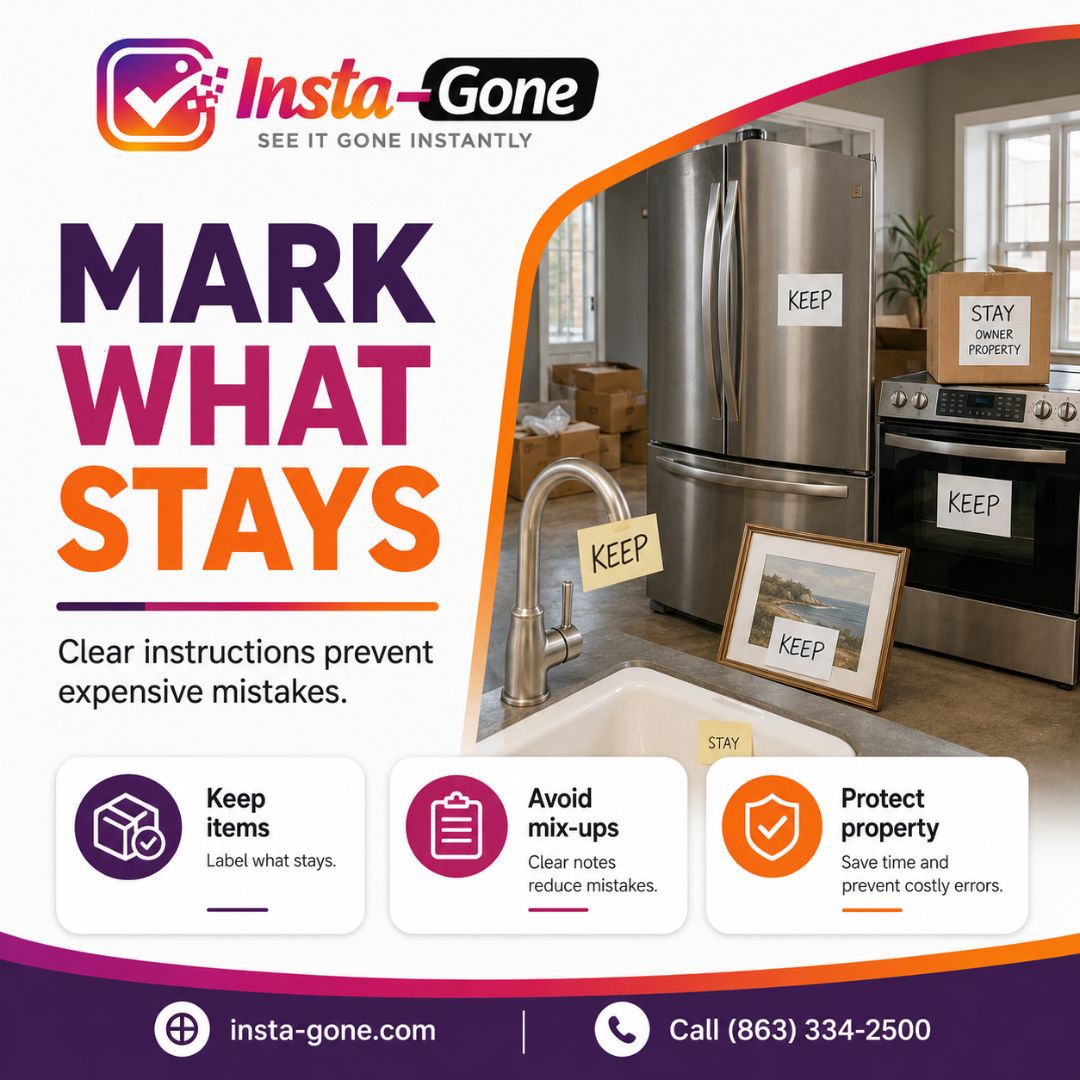
Mark What Stays
One of the most important cleanout instructions is also one of the easiest to overlook: clearly identify what must remain.
Do not rely on memory or verbal instructions alone when a property contains a mix of removable items and items that belong to the owner, tenant, contractor, or next occupant. Use labels, tape, written notes, or a simple room-by-room list.
For commercial cleanouts, mark equipment, files, fixtures, tools, inventory, and furniture that should stay. For residential cleanouts, identify personal documents, family items, appliances, stored boxes, or furniture that should not be removed.
If several people are involved, choose one person to provide final instructions. Conflicting directions from a landlord, tenant, employee, family member, or contractor can slow the process and increase the chance of mistakes.
Clear markings protect important items and allow the crew to work with more confidence.
Prepare the Property Before the Cleanout
A little preparation can make the cleanout easier to coordinate.
Confirm who will provide access and whether someone must be present. Remove personal documents, medications, keys, cash, and other small valuables before the crew arrives. Separate anything being donated, transferred, sold, or kept so it is not mixed with the removal area.
For business properties, notify building management, security, or neighboring tenants when needed. Confirm elevator rules, loading restrictions, gate access, and parking instructions. If the cleanout involves several rooms, provide a simple map or written scope.
It is also useful to take your own “before” photos. These give property managers, landlords, business owners, and homeowners a clear record of the original condition.
Finish With a Walkthrough
A cleanout should end with a clear review of the space.
Walk through each room, storage area, office, garage, or commercial section included in the scope. Check corners, closets, cabinets, shelving, back rooms, and outdoor areas that were part of the job. Confirm that the items marked to stay are still in place and that the removal areas are ready for the next step.
For property turnovers, photos after the cleanout can help document completion for owners, managers, contractors, or remote decision-makers. A final walkthrough also gives everyone a chance to catch a missed area before access is closed or the property changes hands.
Clear Information Leads to a Faster Cleanout
When a property has a deadline, speed comes from preparation. Wide photos show the full scope. Exact location details explain access. A real deadline connects the cleanout to the next task. Clear markings protect what stays.
Insta-Gone handles commercial and residential cleanouts with an organized approach built around property needs, clear instructions, and clean finishes. The goal is not only to remove unwanted items, but to help move the space toward its next use without unnecessary confusion.
Need the space cleared fast? Call Insta-Gone at (863) 334-2500 and let’s get it handled.